| South Africa Weekly Macro-Financial Dashboard | |||||||
| Week ending 19 June 2026 | |||||||
| Metric | Start 2026 | Previous Week | Current Week | Weekly Change | YTD Change | Weekly Signal | YTD Signal |
|---|---|---|---|---|---|---|---|
| SARB Repo Rate | 6.75% | 7.00% | 7.00% | 0 bps | +25 bps | Neutral | Negative |
| Prime Lending Rate | 10.25% | 10.50% | 10.50% | 0 bps | +25 bps | Neutral | Negative |
| SA 5-Year Government Yield | 8.50% est. | 8.10% est. | 7.96% | -14 bps est. | -54 bps est. | Positive | Positive |
| SA 10-Year Government Yield | 8.20% | 8.65% est. | 8.48% | -17 bps est. | +28 bps | Positive | Negative |
| SA 20-Year Government Yield | 9.20% est. | 9.25% est. | 9.05% | -20 bps est. | -15 bps est. | Positive | Positive |
| SA 30-Year Government Yield | 8.95% | 9.10% est. | 8.93% | -17 bps est. | -2 bps | Positive | Neutral |
| Headline CPI | 3.6% | 4.0% | 4.5% | +50 bps | +90 bps | Negative | Negative |
| USD/ZAR | 16.57 | 16.41 | 16.40 | -0.01 | -1.0% | Positive | Positive |
| FTSE/JSE All Share Index | 115,832 | 110,254 | 112,611 | +2.14% | -2.78% | Positive | Negative |
| Brent Crude | $73–75 est. | $88.64 | $80.50 approx. | -9.2% approx. | +9% est. | Positive | Negative |
| Sources: SARB, Stats SA, National Treasury, JSE and Linkage Analytics calculations. Values marked est. are estimates and approx. indicates an approximate market reference. | |||||||
South Africa Weekly Macro-Financial Monitor
Fixed Income, Currency, Equities and Macro-Financial Conditions
South Africa
Fixed Income
Government Bonds
Financial Markets
Weekly analysis of South African bonds, inflation, the rand, equities and key market risks.
Executive Summary
This weekly report reviews key developments in South African financial markets, with particular focus on government bonds, interest rates, inflation, the rand and equity-market performance.
The report compares the latest market levels with the previous week and the beginning of 2026. It therefore presents both weekly changes and year-to-date changes.
Weekly Macro-Financial Dashboard
Key Weekly Takeaways
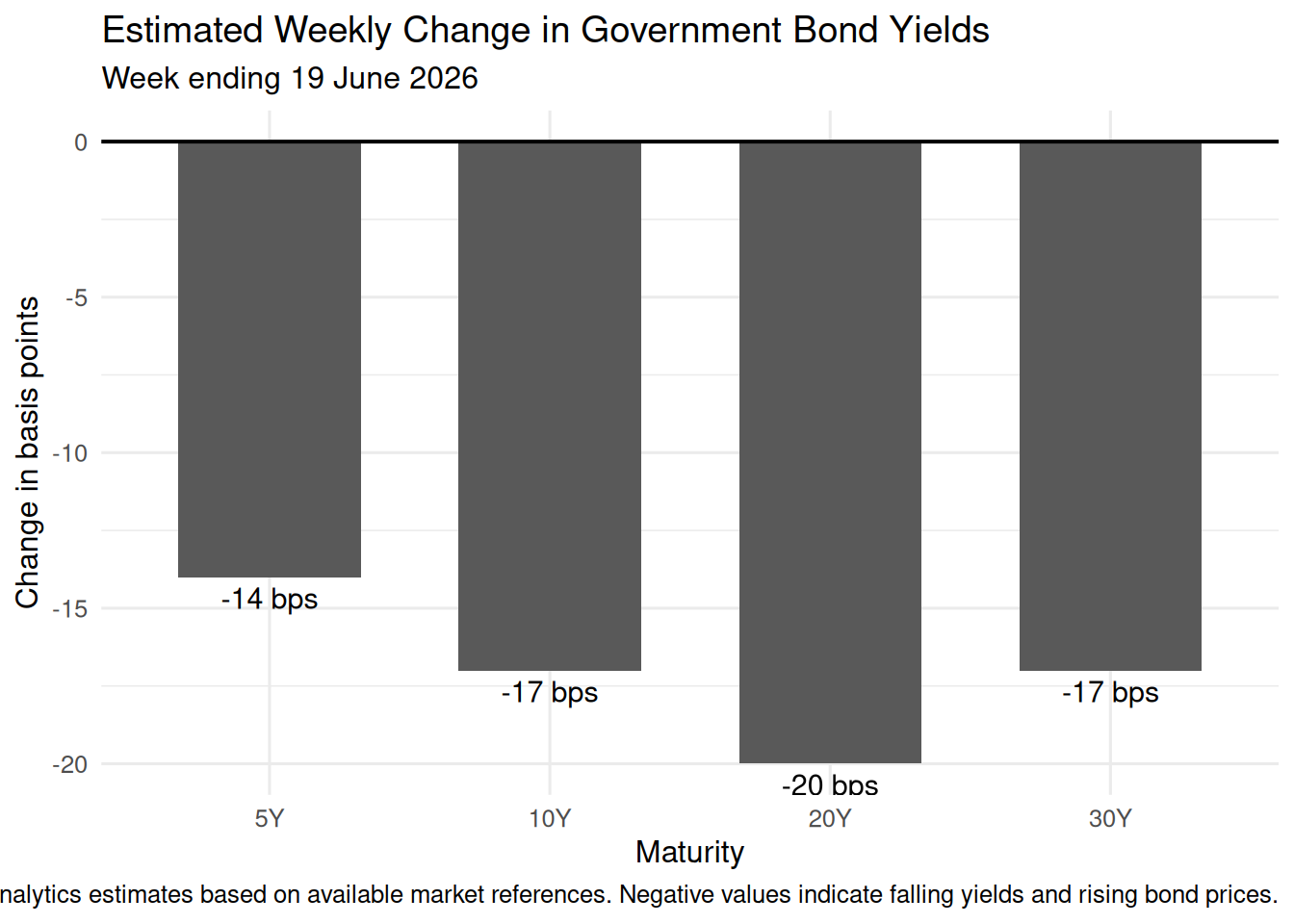
- South African government bonds strengthened across the curve, with estimated yield declines of approximately 14–20 basis points.
- The 10-year government bond yield declined to approximately 8.48%, although it remained above its level at the beginning of 2026.
- The latest inflation outcome reduced expectations of another immediate SARB interest-rate increase.
- The rand remained resilient at approximately R16.40 per US dollar.
- The FTSE/JSE All Share Index gained 2.14% during the week.
- Financial shares outperformed, while resource shares weakened.
- Lower Brent crude prices improved South Africa’s near-term inflation outlook.
Fixed-Income Market
South African government bonds strengthened during the week as investors reassessed the outlook for inflation and monetary policy.
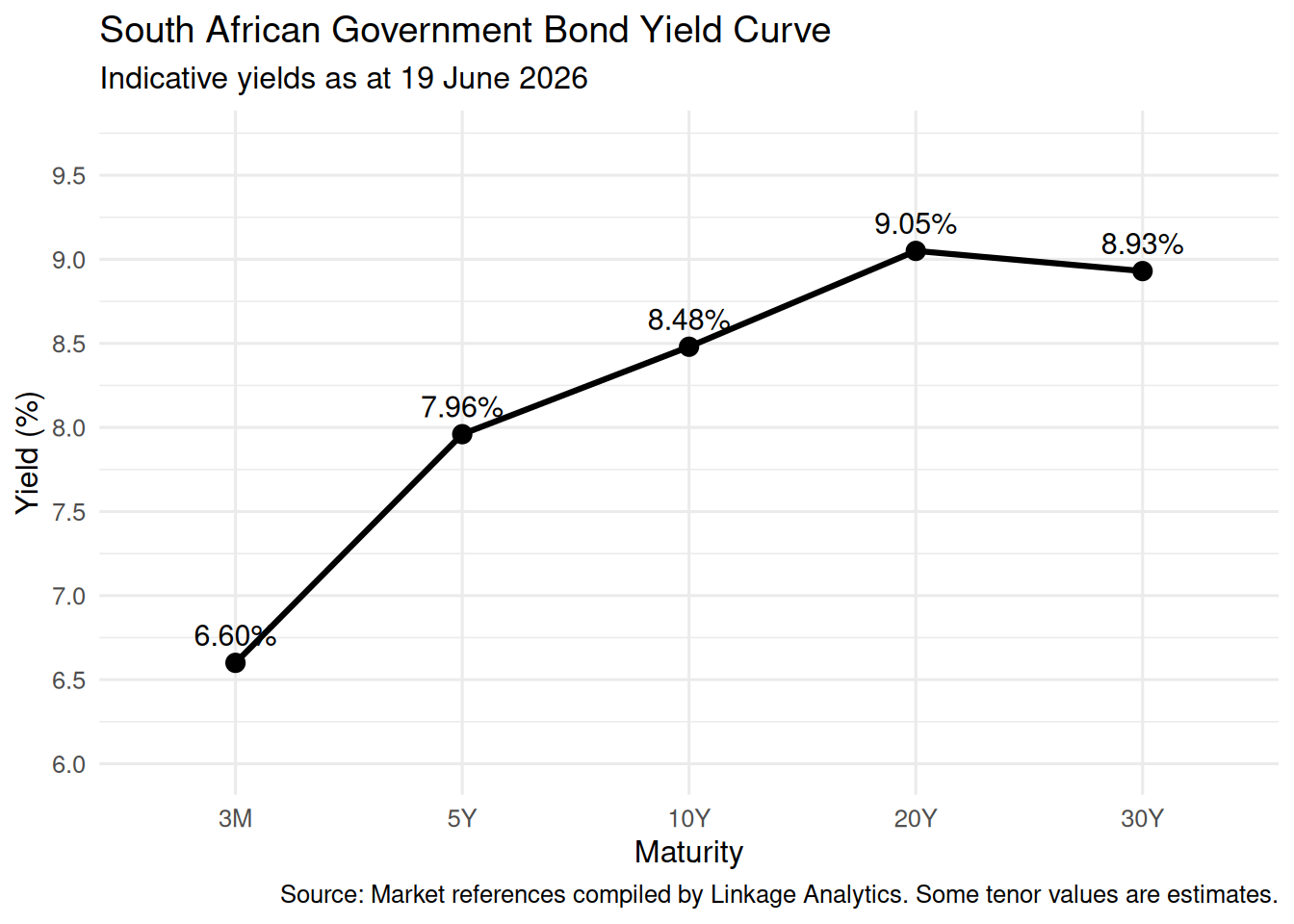
Estimated yields declined across the medium- and long-term areas of the government bond curve. The 5-year yield declined to approximately 7.96%, while the 10-year yield moved to about 8.48%. Longer-dated yields also declined, with the 20-year and 30-year areas ending near 9.05% and 8.93%, respectively.
For existing bondholders, falling yields translated into capital gains. For new investors, however, lower yields mean that the entry-level income available from government bonds declined slightly during the week.
The rally was supported by lower inflation concerns, strong demand at the government bond auction, and improved sovereign-rating sentiment. However, South African bonds remain exposed to fiscal risks, global interest rates, commodity-price developments and changes in foreign investor demand.
Inflation and the SARB Policy Outlook
South Africa’s inflation outlook was the most important domestic driver of the bond market during the week.
Headline inflation for May 2026 was reported at 4.5% year on year, while monthly inflation was 0.7%. Although inflation remained above the level recorded at the beginning of the year, the outcome was lower than some market expectations and reduced concerns about an immediate additional interest-rate increase.
The SARB repo rate remained unchanged at 7.00% during the week, while the prime lending rate remained at 10.50%. The policy stance therefore continued to be restrictive, with borrowing costs remaining elevated for households and businesses.
The softer-than-expected inflation outcome was supportive of government bonds because it reduced the perceived need for further near-term monetary tightening. This contributed to the decline in medium- and long-term bond yields.
However, the inflation outlook remains exposed to several risks, including:
- changes in fuel prices;
- global oil-market volatility;
- rand depreciation;
- administered-price increases;
- food-price pressures; and
- possible second-round effects from higher transport and production costs.
The decline in Brent crude prices during the week improved the near-term inflation outlook and reduced the probability of a further immediate rate increase. Nevertheless, the SARB is likely to remain cautious until there is clearer evidence that inflation is stabilising sustainably.
Monetary-Policy Interpretation
The weekly market movement suggests that investors shifted toward a stronger expectation of a policy-rate hold at the next SARB meeting.
This does not necessarily imply that interest-rate cuts are imminent. The repo rate remains high relative to current inflation, but the SARB will continue to balance inflation risks, exchange-rate stability, domestic growth and global financial conditions.
For fixed-income investors, a stable policy rate combined with moderating inflation would generally support government bonds. A renewed rise in inflation or a sharp weakening of the rand would, however, increase the risk of higher yields.
The Rand and External Conditions
The rand remained relatively resilient during the week, ending at approximately R16.40 per US dollar compared with about R16.41 in the previous week.
Although the weekly movement was small, the rand remained stronger than its level at the beginning of 2026. This provided some support to the domestic inflation outlook by reducing the cost of imported goods and limiting exchange-rate pressure on fuel and other internationally priced products.
The rand’s performance was supported by improved demand for South African bonds, positive sovereign-rating momentum and the decline in global oil prices. Lower oil prices are generally supportive of South Africa’s external position because the country is a net importer of crude oil.
However, the currency remains sensitive to:
- changes in United States interest-rate expectations;
- global risk appetite;
- foreign investment flows into South African bonds and equities;
- domestic fiscal and political developments;
- commodity prices; and
- changes in the US dollar.
A sharp rise in global yields or a deterioration in domestic risk sentiment could weaken the rand and place renewed pressure on inflation expectations.
Commodity-Market Developments
Brent crude declined sharply during the week, falling from approximately US$88.64 per barrel to around US$80.50.
This decline was positive for South Africa’s inflation outlook and for fuel-import costs. It may contribute to lower domestic fuel prices if the reduction is sustained.
Gold also weakened during the week, while platinum performed more positively. The movement in commodity prices contributed to a mixed performance among South African resource shares.
For the South African economy, lower oil prices are broadly supportive, while weaker precious-metal prices may reduce earnings expectations for mining companies and place pressure on export revenues.
Equity-Market Performance
South African equities delivered a positive overall performance during the week, although returns differed significantly across sectors.
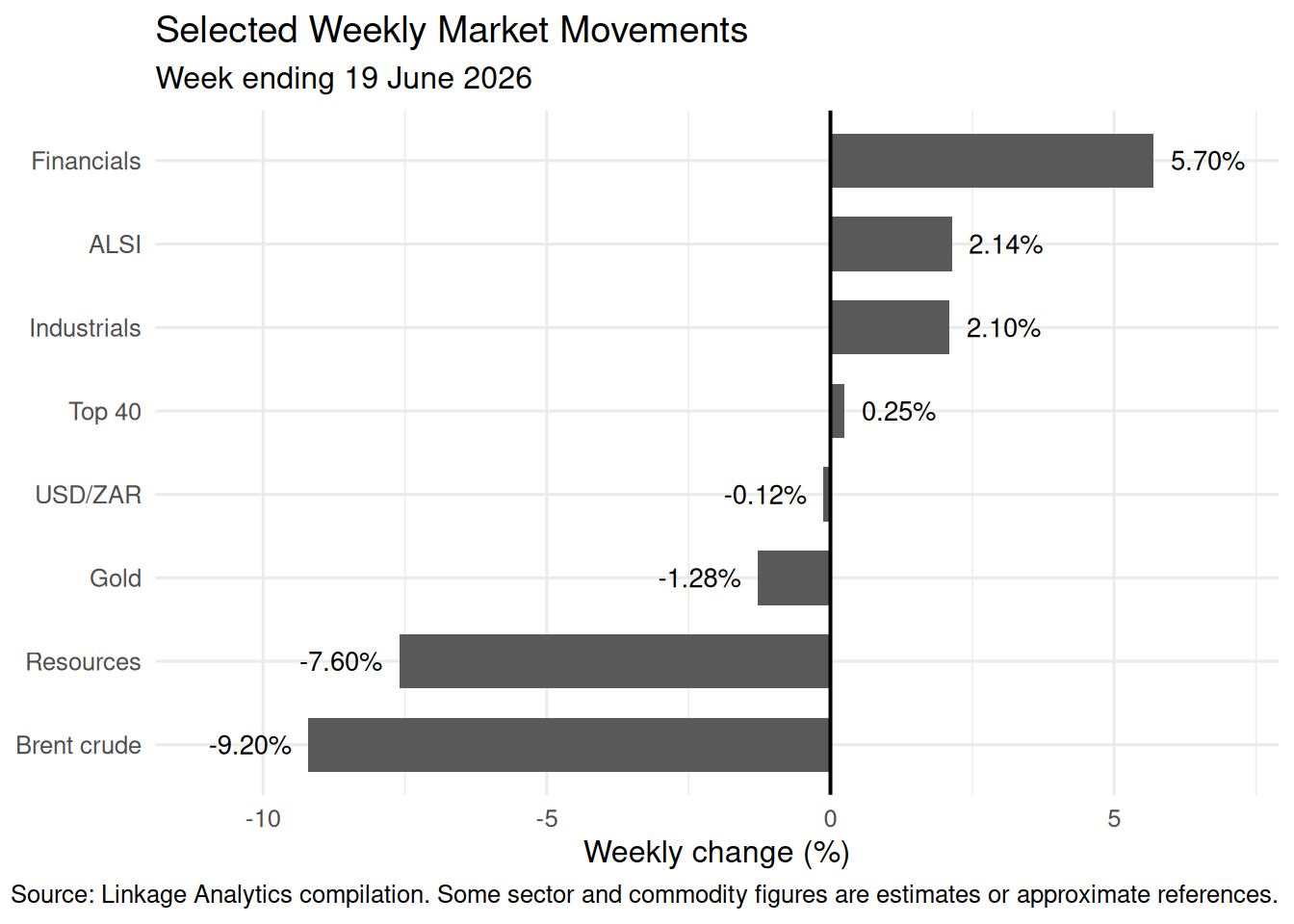
The FTSE/JSE All Share Index increased from approximately 110,254 to 112,611, representing a weekly gain of about 2.14%. Despite this improvement, the index remained below its level at the beginning of 2026.
Financial shares were among the strongest performers during the week. The sector benefited from improved domestic sentiment, lower bond yields and reduced expectations of an additional immediate interest-rate increase.
Industrial shares also recorded gains, supported by improved market sentiment and the more favourable inflation outlook.
Resource shares weakened sharply. The decline reflected lower commodity prices and a reversal in parts of the mining sector. Gold weakened during the week, while the decline in energy prices placed additional pressure on commodity-linked shares.
The sector divergence highlights that the broader equity-market increase was not evenly distributed. Financial and industrial shares provided most of the support, while resources acted as the main drag.
Equity-Market Interpretation
Lower government bond yields are generally supportive of equity valuations because they reduce the discount rate applied to future company earnings.
The effect is particularly relevant for interest-rate-sensitive sectors such as financials, property and consumer-facing companies. However, company earnings, global growth expectations and commodity prices remain important drivers of equity performance.
The positive weekly movement should therefore be interpreted as an improvement in sentiment rather than evidence of a broad and sustained equity-market recovery.
Investor Implications
The week’s market movements created different implications across asset classes and investor groups.
Government Bond Investors
Existing holders of medium- and long-dated South African government bonds benefited from falling yields and rising bond prices.
The estimated decline of approximately 14–20 basis points across the curve generated positive weekly returns. However, the 10-year yield remained above its level at the beginning of 2026, which means that the broader year-to-date picture is still mixed.
For new investors, lower yields reduce the income available at entry compared with the previous week. Nevertheless, South African government bonds continue to offer relatively high nominal yields compared with many developed markets.
Equity Investors
Financial and industrial shares benefited from improved domestic sentiment and lower bond yields.
Resource shares remained vulnerable to weaker commodity prices and shifts in global risk sentiment. Investors should therefore distinguish between broad JSE performance and sector-specific performance.
Currency Investors
The rand’s resilience supported South African assets by limiting imported inflation pressure.
However, the currency remains sensitive to global interest rates, the US dollar, foreign portfolio flows, fiscal developments and political risk.
Corporate Borrowers
Lower government bond yields are generally supportive of corporate funding conditions because sovereign yields form an important reference point for corporate borrowing costs.
However, the final cost of borrowing also depends on the company’s credit quality, maturity, liquidity and prevailing corporate credit spreads.
Property and Interest-Rate-Sensitive Assets
Lower long-term bond yields are generally supportive of listed property and other interest-rate-sensitive assets because they reduce discount rates and improve the relative attractiveness of income-producing investments.
The benefit will depend on whether the decline in yields is sustained.
Overall Investment Signal
The weekly signal was positive for South African fixed income and selected domestic equity sectors.
The year-to-date picture remained more cautious because inflation was higher, policy rates had increased and some asset classes remained below their levels at the beginning of the year.
Policy Implications
The weekly market developments carry important implications for monetary policy, fiscal policy and government borrowing conditions.
Monetary Policy
The lower-than-expected inflation outcome reduced pressure on the SARB to raise interest rates again in the near term.
A more stable inflation outlook would allow the SARB to maintain the current policy rate while assessing the effects of previous tightening. However, the central bank is likely to remain cautious because inflation risks remain sensitive to the rand, fuel prices and administered-price increases.
Fiscal Policy
The bond rally and strong demand for government securities improved the immediate funding environment for the National Treasury.
Lower bond yields reduce the marginal cost of new government borrowing. However, the improvement will only be sustained if investors remain confident in fiscal consolidation, debt stabilisation and the government’s ability to control expenditure.
Government Debt Management
Strong auction demand indicates that the domestic bond market continues to absorb government issuance.
Nevertheless, high debt-service costs remain a major fiscal constraint. A sustained decline in yields would help reduce refinancing pressure, but this would require continued progress in inflation control, fiscal credibility and economic reform.
Growth and Investment
More stable interest-rate expectations may support business confidence and investment planning.
However, borrowing costs remain relatively high, and weak economic growth could continue to limit private-sector credit demand and capital expenditure.
Overall Policy Signal
The weekly policy signal was moderately positive.
Financial conditions improved, but the underlying policy environment remains constrained by high public debt, elevated borrowing costs, weak growth and external market risks.
What to Watch This Week
Investors should monitor the following developments during the coming week:
- the next National Treasury bond auction and its bid-to-cover ratio;
- movements in the 10-year and 30-year government bond yields;
- changes in USD/ZAR;
- global oil and gold prices;
- US inflation and interest-rate expectations;
- foreign portfolio flows into South African bonds and equities;
- domestic political and fiscal developments; and
- any new commentary from the SARB.
Key Market Levels
| Indicator | Level to Watch | Interpretation |
|---|---|---|
| SA 10-Year Government Yield | 8.20% | A move below this level would strengthen the bullish bond-market signal |
| SA 10-Year Government Yield | 8.70% | A move above this level would indicate renewed selling pressure |
| USD/ZAR | 16.20–16.25 | Rand support area |
| USD/ZAR | 16.60 | A move above this level would indicate renewed rand weakness |
| Brent Crude | US$80 per barrel | Sustained prices below this level would support the inflation outlook |
| FTSE/JSE All Share Index | 112,000 | Near-term market support area |
The most important near-term risk remains a reversal in global oil prices or a sharp increase in global bond yields. Either development could weaken the rand, raise inflation expectations and place renewed upward pressure on South African bond yields.
Data Sources and Limitations
This report draws on publicly available information from the South African Reserve Bank, Statistics South Africa, National Treasury, the Johannesburg Stock Exchange, institutional market commentary and selected secondary market-data sources.
Some figures in this report are estimates or approximate market references because exact historical closing data for specific dates was not available from a freely accessible primary source.
In particular:
- some government bond yields for the previous week and the beginning of 2026 are estimates;
- some JSE sector-index values are approximate;
- selected commodity prices are based on available market references rather than official settlement prices;
- the 10-year breakeven inflation measure is a proxy and is not calculated using a fully duration-matched traded inflation-linked bond;
- corporate credit spreads are not included because verified live market prices were not available;
- weekly changes calculated from estimated observations should be interpreted cautiously.
Values marked est. are estimates.
Values marked approx. are approximate market references.
The report separates confirmed observations from estimates wherever possible. The analysis should therefore be interpreted as macro-financial market intelligence rather than as a substitute for Bloomberg, IRESS, LSEG Workspace or official exchange-level market data.
Disclaimer
This report is published for informational and analytical purposes only.
It does not constitute investment advice, financial advice, trading advice, a recommendation, an offer to buy or sell any financial instrument, or a solicitation to undertake any investment activity.
Although reasonable care has been taken in preparing this report, Linkage Analytics does not guarantee the accuracy, completeness or timeliness of all information, particularly where figures are identified as estimates or approximate market references.
Financial markets involve risk, and past performance is not a reliable indicator of future results. Readers should conduct their own research and obtain professional advice appropriate to their circumstances before making investment decisions.
© 2026 Linkage Analytics. All rights reserved.